The situation
The chair does everything except hold your drink.
A recliner is the most machinery you'll ever sit on — levers, motors, a mechanism that knows how to hug a wall. And the drink still ends up wherever it can.
The built-in cupholder, if you have one.A plastic cup sunk into the arm, sized before the big-tumbler era. Some theater-chair holders are barely wider than a soda can, most are only a couple inches deep, and the popular 30-and-40-ounce class lands at or past the top of what they take. A foot of insulated steel standing in a shallow socket is mostly lever.
The rolled arm.Padded, rounded, sloped — built for a forearm, not a glass. Anything set on it rides the curve, and the fabric caddies sold to fix it slide on the same slope they were supposed to solve.
Between your knees.The default holder the moment the footrest comes up. It's a grip, not a holder — every reach for the remote and every shift of the blanket asks that hand to do two jobs at once.
The side table.Layout guides tell you to park it behind the armrest line so the tilting mechanism clears it. That keeps the table safe from the chair — and puts your drink behind your shoulder the moment you lean back.
The floor beside the chair.The fallback when the room has no table at all. It waits at arm's-dangle depth, below your sightline, in the sweep of the extending footrest — a full sideways bend from a reclined position.
No single evening goes wrong. But you bought the most comfortable chair in the house, and it still can't hold a drink.
You know the moment
The footrest comes up, and one of these begins.
Movie night, minute 20The footrest is up, the blanket is settled, and the bottle is where it always goes — clamped between your legs. You've held it there so many nights you've stopped calling it holding. Then the remote turns out to be on the coffee table, a full footrest's length away.
9:45 PMYou lean the chair all the way back and the room rearranges itself: the side table that sat at your elbow is suddenly behind your shoulder. Getting to the drink means folding the whole chair forward and starting over.
Sunday, third quarterThe 40-ounce came to the game but doesn't fit the armrest hole — it never has. So it stands on the carpet beside the chair, and before the footrest ever comes down you check where it is first.
The night everyone's overRecliners for everybody, surfaces for nobody — the room only ever had floor space for the chairs. The sodas end up on the carpet next to each seat, and the whole family spends the evening half-watching their feet.
What you get
Three reasons it stays out.
01Settles in on the arm — or on your lap
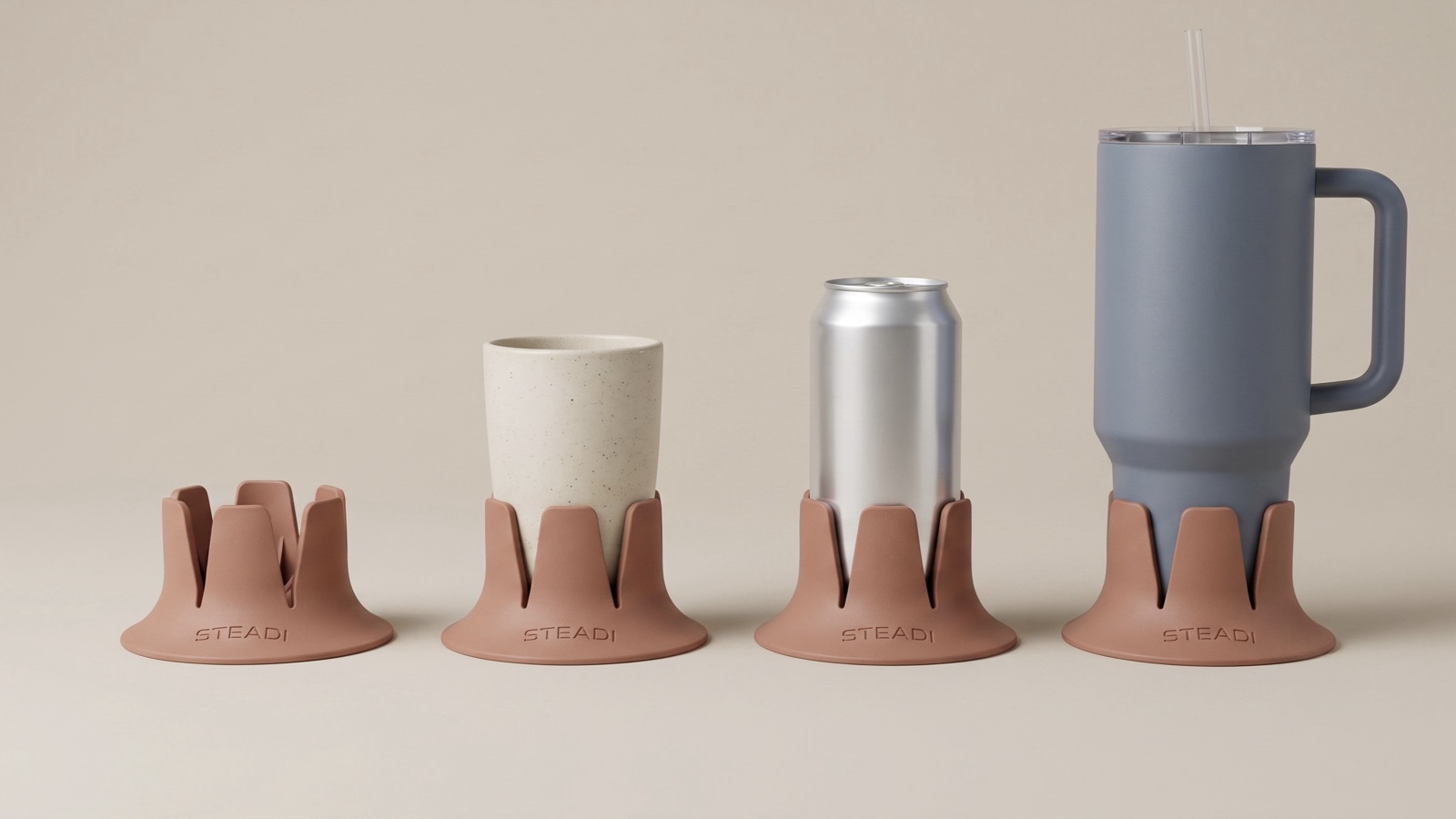
The wide flexible base settles onto padded, rounded, tilting surfaces instead of riding their slopes. Recline, rock, reach across — the base flexes with whatever it's sitting on and the drink settles back level.
02Takes the tumbler the armrest couldn't
The big insulated cups outgrew furniture cupholders. Here, flexible fins grip anything with a base about 2 to 3 inches across — the 40 oz Stanley drops in and gets held by its bottom inch, no adapter, no insert swap.
03Kind to the chair
No pilot holes in the armrest, no clamps, no straps. One piece of matte flexible material in muted colors, with nothing to scratch leather or snag fabric — it sits where you put it and moves to whichever seat needs it tonight.
Chair anatomy
The most engineered seat in the house, and nowhere flat to set a glass.
Drinks don't fail in a recliner because you're careless. They fail because everything within reach is padded, sloped, or about to move.
The built-in cupholderA plastic drop-in cup sized before the insulated-tumbler era — only a couple inches deep, barely wider than a soda can at the small end, and prone to sticking: a sweating cup adheres to the plastic and lifts the whole holder out of the armrest with the drink. Replacement inserts are sold with drain holes because condensation pooling in them is that routine.
The rolled armUpholstered, rounded, sloped — there is no flat spot on it. Anything set there rides the curve, which is why the accessories built for it are all straps and counterweights fighting the same geometry.
Your lap, footrest upThe default holder once you're tilted back — a grip, not a surface. It works exactly until you need that hand, and an evening in a recliner is a long list of needing that hand.
The side-table zonePlacement guides park the table a few inches behind the armrest so the mechanism can tilt past it — safe for the furniture, out of reach for the sitter. The same guides tell you to test the reach while reclined before you ever buy one.
The floor alongsideArm's-dangle depth, below your sightline, in the path of the extending footrest. Retrieving a drink from down there is a blind sideways bend past the armrest — and the space in front of the chair belongs to the mechanism, not the glass.
Versus what you do now
The aftermarket you've already been through.
The fabric armrest caddyIt's cloth on a curve. The arm gives the caddy the same slope it gives everything else, and the caddy takes the trip — off the arm, onto the floor, pockets and all. Even while it stays put, the cup pocket holds the drink at whatever angle the arm happens to be offering, and fabric absorbs a spill instead of stopping one.
The cupholder expander adapterA fix that requires the thing it's fixing. It only helps if your chair already has a holder, and only one inside its size window — the classic recliner with no cupholder at all, and the can-width theater cup, get nothing from it.
The clamp-on or socket tray tableThe socket kind needs an exact cupholder diameter that no two furniture brands agree on — owners measure their chairs and still come up empty — and a loaded tray levers against the small plastic cup it's plugged into until something gives. Reviewers of the clamp kind report the tray tipping the moment it's leaned on.
The side tableDoes its best work when the chair is upright — which is exactly when you least need it. Parked behind the armrest line to survive the mechanism, it sits behind your shoulder once you recline. And plenty of rooms with a recliner set never had floor space for one in the first place.
The DIY bolt-onThe forum threads are full of it — car-door cupholders screwed to the armrest fronts, PVC sleeves, marine hardware whose drain holes pass a spill straight through to the carpet. It means drilling pilot holes into furniture you paid real money for, and the add-ons snap off when a coat catches them.
Before you buy
Questions people actually ask.
Does it actually stay put on a padded armrest?
That's the shape's whole job. Narrow bases sink and lean on upholstery; the wide flexible footprint spreads across the padding instead of pressing into it, and the fins keep the drink from rattling loose as the chair moves. Nudge it off level and it settles back.
My recliner never came with a cupholder. Is this the fix?
That's the most common chair there is. Even the biggest name in recliners went years without a single-chair cupholder — cupholders lived in the loveseat console, and the chair itself went bare. This adds the drink spot without adding anything to it: it sits on the arm or your lap, and there's nothing to install.
My chair has a cupholder — it's just useless.
Built-in drop-in cups were sized before the insulated-tumbler era: a couple inches deep, some barely wider than a soda can — and the popular 30-and-40-ounce class starts about where their range ends. This holds the drink by gripping its bottom inch from the sides, instead of asking a shallow socket to steady a foot of steel.
Will my tumbler fit?
Check the bottom, not the rim. A base about 2 to 3 inches across settles in — the 40 oz Stanley does. Handled mugs are the exception: the handle sits right where a fin needs to grip.
Does anything bolt, clamp, or strap to the chair?
No. No pilot holes, no clamps on the arm, no straps around the back — nothing touches the leather or fabric but the soft base itself. That also means it moves: either arm, any chair, whichever seat needs it tonight.
What happens when I recline — or when the rocker is rocking?
Reclining is the use case, not the edge case. The backrest tilts, the footrest swings, the rocker rocks — the base flexes with whatever it's sitting on and settles the drink back level through all of it. It resists tipping; it doesn't repeal physics, and a hard sideways knock can still beat any holder — but a chair moving the way a recliner moves is what the shape was drawn around.
Where am I supposed to put it, exactly?
Wherever your reach already is: the armrest, your lap once the footrest is up, the seat cushion beside you on a wide chair, the console top, or the floor at arm's length. It works at least as well on hard, flat surfaces as on soft ones.
My sweating cup used to pull the old plastic insert out with it.
A known failure of drop-in holders — condensation sticks the cup to the plastic, and the whole insert rides up out of the armrest with the drink. Here the flexible fins grip from the sides and flex to let the cup lift out, so raising your drink doesn't mean raising the holder. Wipe the base down whenever you'd wipe a coaster.
How do I clean it?
Sink or dishwasher — either works. It's one molded piece of flexible material: no seams, no socket, no parts to lose.
Who makes it, and where do I buy one?
It's called the Steadi, molded in small runs in Orange, California by Steadi Labs — veteran-founded and patent pending. Every order ships free from steadilabs.com, and you get 30 days to change your mind.